
Need helping fixing or adding a dental crown? Call Preventive
Dental today on 020 8874 3877.
 What is a crown?
A dental crown is an artificial restoration that fits over the remaining part of a prepared tooth, making it strong and giving it the shape of a natural tooth. A crown is sometimes known as a ‘cap’.
Morris Weinstein is the practice owner and specialist for dental crowns. For any questions or to book an appointment, contact Dr Weinstein today by phone or email us at smiles@preventivedental.com.
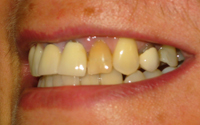
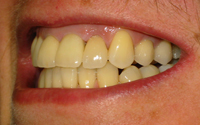
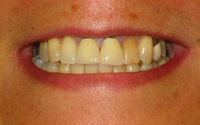
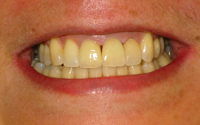
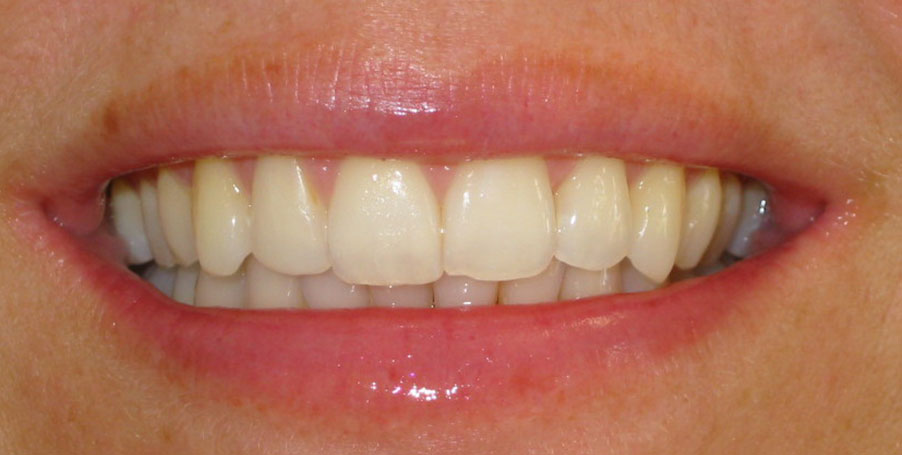
Dental Crowns Before and After
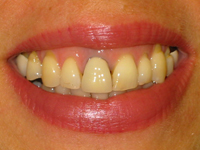
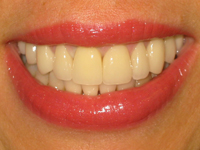
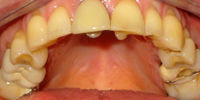
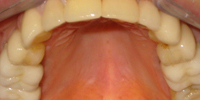
Why would I need a crown?
Crowns are an ideal way to repair teeth that have been broken, or have been weakened by decay or a very large filling. A crown could be used for a number of other reasons, for example:
- You may have a discoloured filling and would like to improve the appearance of the tooth
- You may have had a root filling and need a crown to protect what is left of the tooth
- It may help to hold a bridge or denture firmly in place.
What is a crown made of?
Crowns can be made of a variety of different materials and new materials are continually being introduced. Some of the most popular options are:
- Porcelain bonded to precious metal: this is what most crowns are made from. A precious metal base is made and then porcelain is applied in layers over it.
- Porcelain: these crowns are made entirely out of porcelain and are not as strong as bonded crowns. But they can look very natural and are most often used for front teeth.
- All-ceramic: this modern technique offers a metal-free alternative, which can give the strength of a bonded crown and the appearance of a porcelain crown. Therefore it is suitable for use in all areas of the mouth.
- Glass: these crowns look very natural and can be used anywhere in the mouth.
- Gold-alloy crowns: gold is one of the oldest filling materials. Today it is used with other metal alloys to increase its strength, which makes it very hardwearing. These crowns are silver or gold in colour.
How is a crown prepared?
The dentist will prepare the tooth to the ideal shape for the crown. This will involve removing a layer of the outer surface, leaving a strong inner core. The amount of the tooth removed will be the same as the thickness of the crown.
Once the tooth is shaped, the dental team will take an impression (mould) of the prepared tooth, one of the opposite jaw and possibly another to show the way you bite together.
The impressions will then be given to a dental technician, along with information about the shade to use and any other information they need.
What is a post crown?
In root-filled teeth it may be necessary to insert a post into the tooth root before placing a crown. A post gives support and helps the crown to stay in place. The surface of the tooth may be removed down to the level of the gum.
A post can be made of prefabricated stainless steel which the dentist can fit directly into the root canal. Or a custom-made post can be constructed by a dental technician to accurately fit the shape of the prepared root canal. The post is placed into the root canal and cemented in position, ready for the crown to be attached.
Are there any alternatives to post crowns for root-filled teeth?
If a root-filled tooth is not completely broken down, it may be possible for your dentist to build it up again using filling material. This ‘core’ is then prepared in the same way as a natural tooth and the impressions are taken.
Does it hurt to have a tooth prepared for a crown?
No. You will have a local anaesthetic and the preparation work should feel no different from a filling. If the tooth does not have a nerve, and a post crown is being prepared, then you may not need a local anaesthetic.
Will the crown be noticeable?
The crown will be made to match your other teeth as closely as possible. The shade of the surrounding teeth will be recorded, to make sure that the colour looks natural and matches those teeth.
How do I care for my crown?
It is important to keep the crown just as clean as you would your natural teeth. The crown itself cannot decay, but decay can start where the edge of the crown joins the tooth. Brush last thing at night and at least one other time during the day with a fluoride toothpaste, and clean in between your teeth with ‘interdental’ brushes or floss.
To make an appointment for same day crowns in Southfields, call us today on 020 8874 3877 or email us smiles@preventivedental.com.